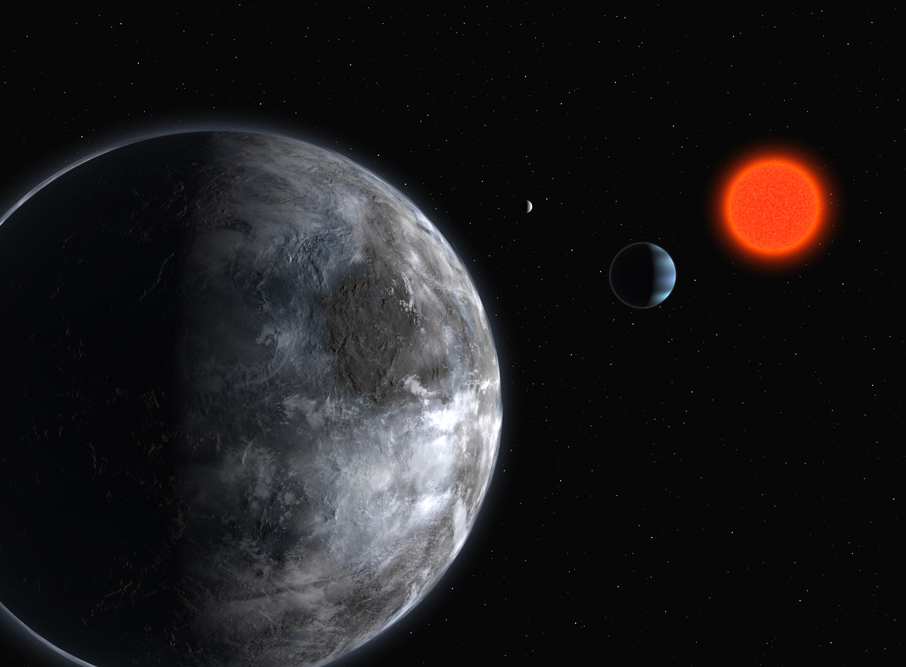
Cambridge, MA - Today, astronomers at the Harvard-Smithsonian Center for Astrophysics (CfA) announced that they have found the most massive known transiting extrasolar planet. The gas giant planet, called HAT-P-2b, contains more than eight times the mass of Jupiter, the biggest planet in our solar system. Its powerful gravity squashes it into a ball only slightly larger than Jupiter.
HAT-P-2b shows other unusual characteristics. It has an extremely oval orbit that brings it as close as 3.1 million miles from its star before swinging three times farther out, to a distance of 9.6 million miles. If Earth's orbit were as elliptical, we would loop from almost reaching Mercury out to almost reaching Mars. Because of its orbit, HAT-P-2b gets enormously heated up when it passes close to the star, then cools off as it loops out again. Although it has a very short orbital period of only 5.63 days, this is the longest period planet known that transits, or crosses in front of, its host star.
"This planet is so unusual that at first we thought it was a false alarm - something that appeared to be a planet but wasn't," said CfA astronomer Gaspar Bakos. "But we eliminated every other possibility, so we knew we had a really weird planet."
Bakos is lead author of a paper submitted to the Astrophysical Journal describing the discovery. That paper is available online at http://arxiv.org/abs/0705.0126.
HAT-P-2b orbits an F-type star, which is almost twice as big and somewhat hotter than the Sun, located about 440 light-years away in the constellation Hercules. Once every 5 days and 15 hours, it crosses directly in front of the star as viewed from Earth-a sort of mini-eclipse. Such a transit offers astronomers a unique opportunity to measure a planet's physical size from the amount of dimming.
Brightness measurements during the transit show that HAT-P-2b is about 1.18 times the size of Jupiter. By measuring how the star wobbles as the planet's gravity tugs it, astronomers deduced that the planet contains about 8.2 times Jupiter's mass. A person who weighs 150 pounds on Earth would tip the scale at 2100 pounds, and experience 14 times Earth's gravity, by standing on the visible surface (cloud tops) of HAT-P-2b.
CfA astronomer and co-author Robert Noyes said, "All the other known transiting planets are like 'hot Jupiters.' HAT-P-2b is hot, but it's not a Jupiter. It's much denser than a Jupiter-like planet; in fact, it is as dense as Earth even though it's mostly made of hydrogen."
"This object is close to the boundary between a star and a planet," said Harvard co-author Dimitar Sasselov. "With 50 percent more mass, it could have begun nuclear fusion for a short time."
An intriguing feature of HAT-P-2b is its highly eccentric (e=0.5) orbit. Gravitational forces between star and planet tend to circularize the orbit of a close-in planet. There is no other planet known with such an eccentric, close-in orbit. In addition, all other known transiting planets have circular orbits.
The most likely explanation is the presence of a second, outer world whose gravity pulls on HAT-P-2b and perturbs its orbit. Although existing data cannot confirm a second planet, they cannot rule it out either.
HAT-P-2b orbits the star HD 147506. With visual magnitude 8.7, HD 147506 is the fourth brightest star known to harbor a transiting planet, making the star (but not the planet) visible in a small, 3-inch telescope.
HAT-P-2b was discovered using a network of small, automated telescopes known as HATNet, which was designed and built by Bakos. The HAT network consists of six telescopes, four at the Smithsonian Astrophysical Observatory's Whipple Observatory in Arizona and two at its Submillimeter Array facility in Hawaii. As part of an international campaign, the Wise HAT telescope, located in the Negev desert (Israel) also took part in the discovery. The HAT telescopes conduct robotic observations every clear night, each covering an area of the sky 300 times the size of the full moon with every exposure. About 26,000 individual observations were made to detect the periodic dips of intensity due to the transit.
Major funding for HATnet was provided by NASA. More information about HAT is available online at http://www.hatnet.hu
Original Source : CFA