Showing posts with label Space Missions and Technology. Show all posts

May 8, 2007

Ariane 5 Carries Two Satellites

An Ariane 5 rocket roared from the European Spaceport in French Guiana on Friday, carrying two satellites into geostationary transfer orbits. The liftoff occurred at 2229 UTC (6:29 pm EDT), after a one day delay because of high-altitude winds. The satellites were released into their transfer orbits 30 minutes after launch.

The first satellite is the ASTRA 1L, which will join a dozen spacecraft in the SES ASTRA constellation. They provide television broadcast and data communications services to 109 million households in Europe.

The second satellite is the Galaxy 17 broadcast satellite, built by Thales Alenia Space, and launched for Intelsat. It became Intelsat's 45th satellite launched aboard an Ariane rocket. Galaxy 17 will park above 74 degrees West above the equator, and provide broadcast services to North America.

This is the second Ariane 5 launch of the year; 4 more are planned.

May 7th, 2007 by Fraser Cain
Original Source: ESA News Release

May 5, 2007

Creating the Conditions Inside Supergiant Planets

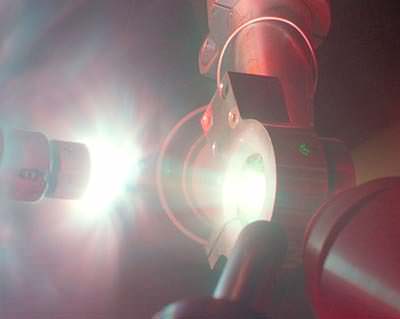
We won't be visiting a supergiant planet any time soon. But physicists are about to do the next best thing, and creat the conditions that exist inside the most dense planets right here on Earth. What used to require a nuclear explosion should now be possible with diamond anvils and powerful lasers.

Researchers from the Lawrence Livermore National Laboratory (LLNL), New Mexico State University and France's Atomic Energy Commission announced this week that they have achieved pressures of 10 million atmospheres using a 30 kilojoule ultraviolet laser. The next step will be to use a 2 megajoule laser to achieve more than a billion atmospheres of pressure. Just for comparison, the centre of the Earth squeezes with a little less than 4 to 5 million atmospheres, and the centre of Jupiter is 70 million atmospheres.

Half of the apparatus uses diamond anvils, which can squeeze liquids and solids under high pressures. The researchers then blast the material with a laser-induced shock wave, and compressing it even more. Of course, you need a laser the size of a building, and half the diamond anvil is vapourized.

Once they reached pressures this high, scientists are discovering entirely new realms of chemistry. The just need to work quickly. The high pressure is only maintained for 1 or 2 nanoseconds.

By Fraser Cain

Original Source: UC Berkeley News Release

Spirit finds an ancient Volcanic Explosion

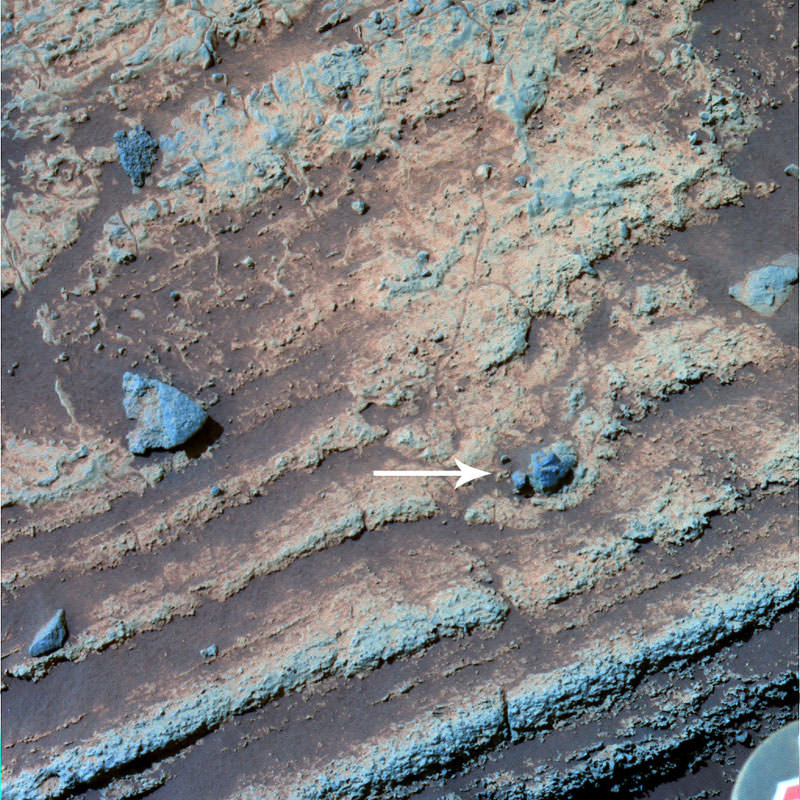
NASA’s Spirit rover has turned up evidence that there was once a massive volcanic explosion in the region it’s currently exploring on the surface of Mars. The region is called “Home Plate”, and it’s an plateau of layered bedrock approximately 2 metres (6 feet) high in Columbia Hills.

Spirit found that that area around Home Plate is mostly basaltic rocks, which are created during very fast lava flows. When the lava makes contact with liquid water, it can explode. So the rocks on Home Plate appear to have been created in this environment of lava and liquid water. More good news for the search for evidence of past liquid water on Mars.

One of the strongest pieces of evidence is what the researchers are calling “bomb sag”. When the lava and water meet, the explosion hurls chunks of rock into the air. One of these pieces of shrapnel came back down and lodged in softer deposits.

It’s hard to believe, but Spirit and Opportunity are now in their 4th year of exploring Mars. NASA reports they’re both in good health and continuing to return science data.

By Fraser Cain

Original Source: NASA/JPL News Release

May 4, 2007

COROT Turns Up its First Planet

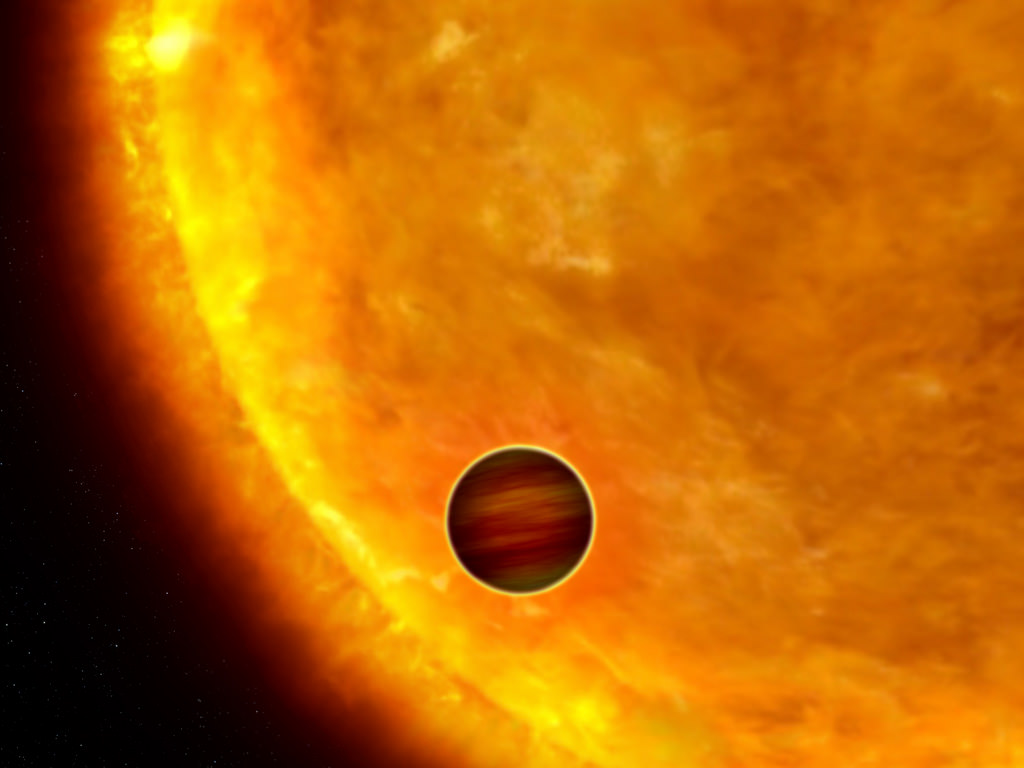
The European Space Agency's COROT planet hunting observatory turned up its first planet - a hot Jupiter - surprising its managers at how quickly it would yield scientific results. COROT was launched in December, 2006, and it has only been making scientific observations for 60 days when it found a planet.

COROT discovers planets using the transit technique. It measures the total light emitted by a star very carefully, watching for a slight dip as a planet passes in front. Once several of these dips have been observed, the planet's size and orbital period can be calculated.

This newly discovered planet, now named COROT-Exo-1b, is a very hot gas giant, with roughly 1.78 times the mass of Jupiter. But unlike Jupiter, it orbits its parent star every 1.5 days. The planet is located about 1500 light-years from Earth in the constellation Monoceros.

Now that it's in orbit, scientists are getting a better sense of COROT's capabilities, and the news is really good. The recent observations show that it's much more sensitive than they had expected. Planets as small as the Earth should be detectable. And here's the great news, COROT should be able to detect the chemical composition of the planets' atmospheres. In other words, COROT will be able to detect the presence of oxygen and other signatures for life on Earth-sized worlds surrounding other stars.

The discovery of life on another planet may just be around the corner.

by Fraser Cain

Original Source: ESA News Release

New Horizons' New Images of Jupiter

Although its primary target will be Pluto, NASA’s New Horizons spacecraft is taking the time to do a little science along the way. During its recent Jupiter flyby, the spacecraft was able to test out its scientific instruments as a dress rehearsal for its final Pluto encounter. NASA held a big press conference this week, and released dozens of new images and scientific findings gathered by New Horizons.

New Horizons made its closest approach to Jupiter on February 28, 2007 when it came within 2.3 million km (1.4 million miles) of the giant planet. As part of this flyby, it captured the closest ever view of Jupiter’s “Little Red Spot”, detailed images of its faint rings, and events on its moons. It made a total of 700 observations, and it’s now transmitting that data back to Earth - 70% of the 34 gigabits of data have been returned so far.

The spacecraft made many discoveries. Here are a few examples. It’s view of “Little Red” shows how these kinds of vast storms evolve in Jupiter’s high atmosphere. It showed how the planet’s rings change quickly, over the course of weeks and months and revealed the effect of a recent impact. It made several observations of Jupiter’s moon Io, with its volcanic plumes scattering lava across its surface.

New Horizons is the fastest spacecraft ever launched. This Jupiter flyby gave it an additional speed boost, and helped put it on target to reach Pluto in 2015.

All the images presented by NASA are available here.
Original Source:
NASA News Release

May 3, 2007

Visiting Venus with Venus Express

Written by Hemal S. Shah

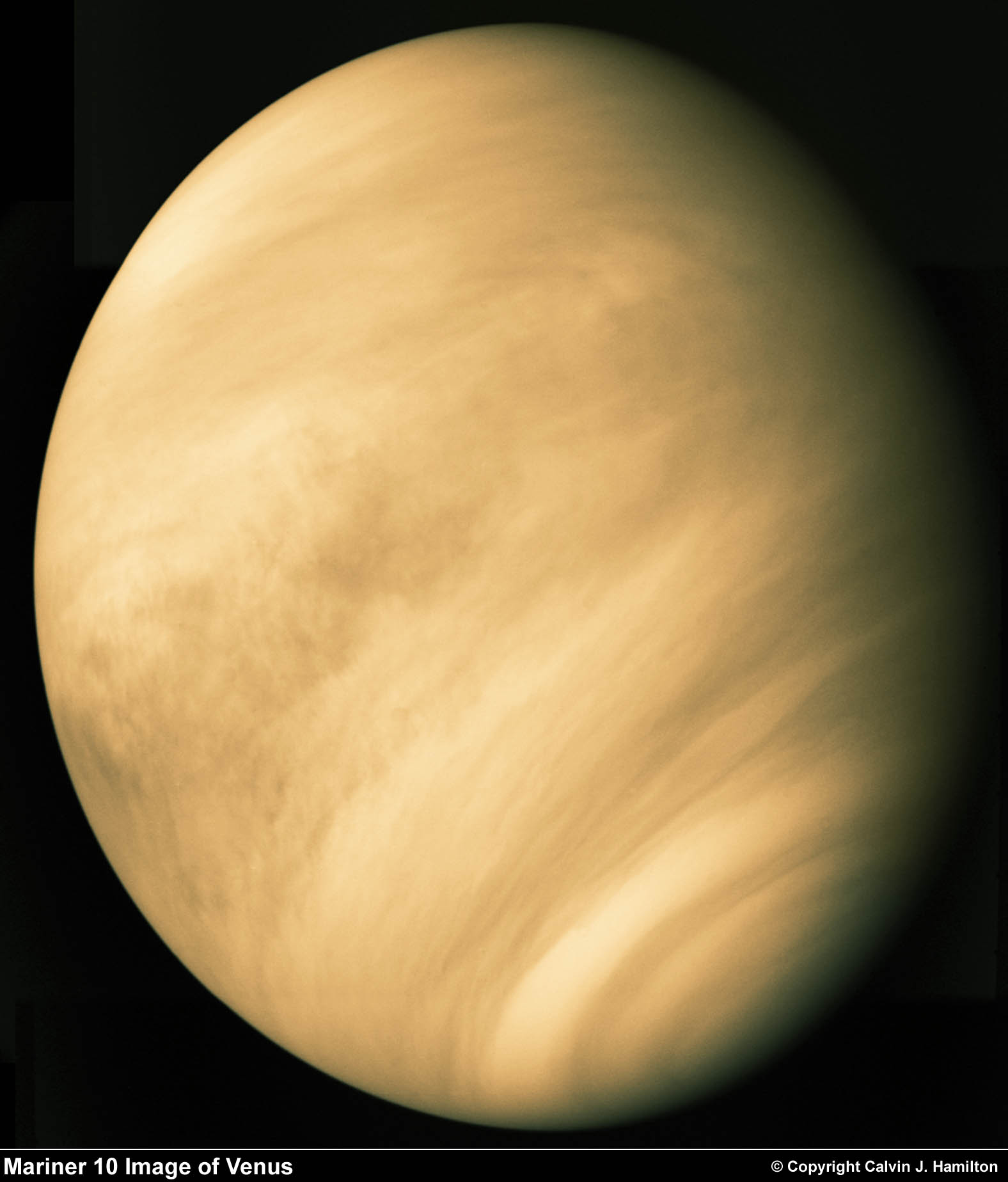
From the ancient times Venus has always remained the most beautiful sight of the night sky. Its fabulous glare outshines every other heavenly object in the night sky accept the Moon. After the Sun and the Moon, Venus is the third brightest object in our sky. The surface temperature on Venus is highest when compared with other planets of the solar system. The temperature is even higher than Mercury, although Mercury is nearest to the Sun!

Venus atmosphere is extremely dense. It contains thick layer of clouds, as much thick as 65 kilometers. So walking on the surface of Venus would be like walking under 3,000 feet of water here on Earth. Any living being would be crushed. The dense atmosphere of Venus reflects 80% of the sunlight that it receives. This is the reason why Venus shines so brightly. Even after reflecting most of the light, the carbon dioxide in the atmosphere traps the heat very efficiently and raises the temperature to as high as 464 degree Celsius. It is known as Green House Effect.

Venus is almost as big as Earth and due to this it is said that Earth-Venus are twin sisters. Apart from the size, rest everything is drastically different between the Earth and the Venus. It orbits the Sun at a distance of 108 million kilometers (10.8 crores).

We have very less information about the surface or the lower atmosphere of Venus. Even the most powerful telescopes cannot penetrate through the dense atmosphere and that is why we do not know much about it.

Up to now only three missions have been dedicated to studying the heavily clouded planet. As a result in order to know more, European Space Agency sent Venus Express onto a 162-day journey to reach the second planet from the Sun. The spacecraft was launched on 8th November 2005 and within 4 hours it set itself into a Venus-bound course and later unfurled its solar array.

Venus Express’ primary goal is to explore close at the Venusian atmosphere, team members are hopeful the spacecraft’s instruments may find hinds of active volcanoes and other features on the planet’s surface.

The ESA officials expect Venus Express to enter orbit around its target planet Venus on April 11 next year. On nearing the planet, probe will make adjustments in its orbit while going around the planet and by about May 7 the probe will reach its final flight configuration.

It is expected that the Venus Express probe will work in good condition for at least 15 months studying the Venusian atmosphere. It might be interesting to know for readers that one Venus day is equal to 243 Earth days. Venus spins very slowly on its axis. Hence the period of 15 months is equal to just two Venus days.

Our the course of the mission the probe will bounce radio waves off the planet’s surface, snap pictures of its swirling atmosphere, take the temperature of the clouds, and search for hints of a magnetic field. All this data will help scientists better understand a planet that from the outside resembles an early Earth and perhaps reveal clues of the existence of life.

Visiting Pluto with New Horizons

Written by Hemal S. Shah

Going to the extremes of the Solar System to unravel the mysteries of its evolution…

Upto a few months ago, our solar system was known to have nine planets orbiting around the Sun. Now the situation is different; a new member is added in the group of planets. Thus, the number of planets is increased to 10 instead of 9. The 10th planet is still an unnamed object. But, the discoverers of the planet are of opinion to name it as Xena.

The new planet could be one and a half times bigger than the size of Pluto. Astronomers have also found out a satellite going around it. Discovery of a satellite is an extremely important finding, as it enables us to estimate the size and the mass of its parent object. The name that is most likely to be given to the satellite is Gabrielle. Both the names, Xena and Gabrielle, are the names of two female friends from some Roman historical story.

We drifted from Pluto to Xena to get updated on some of the latest developments. What we know about Pluto is very less, even though its discovery was made 75 years ago. If compared with the information of other planets, then the information about Pluto that we have shall fit on one page, whereas each planet will consume a book of at least 100 pages.

Man’s quest is to know as much more as possible about everything. Then, why is it so that we know so less about Pluto? There are several viable reasons for this. One of the reasons is its size. In our solar system, there are two satellites, which are bigger than planet Pluto. Isn’t this an interesting fact? One satellite is of Jupiter called Ganymede and another is of the ringed planet Saturn called Titan. To study a planet it is necessary to observe it. Planets do have light of their own. They only reflect the light received from the Sun. Pluto receives very feeble sunlight as it is extremely far from the Sun and because of its smaller size, not much of light gets reflected from its surface. Whatever light is reflected has to come all the way back to Earth for us to examine it. Most of the reflected light from Pluto gets scattered while traveling and whatever light is left gets damaged once it enters the atmosphere of the earth. These are some of the key reasons for our lack of information about Pluto.

The only way we can have loads of information about Pluto is by going very near to it and explore it. The only hurdle in this is the enormous distance between the Earth and Pluto. It is at a mean distance of 5,900 million kilometers from the Sun; whereas Earth is at a mean distance of 150 million kilometers from the Sun. Rest all other planets have been richly explored with the help of space probes like Voyager, Viking, Galileo, Cassini, Mariner, etc.

New Horizons is a space probe exclusively planned for studying the planet Pluto, its companion Charon and than the Kuiper belt objects. The probe shall also study two more objects P1 and P2, which were recently found orbiting the planet.

The New Horizons spacecraft is 8 feet across and weighs 465 kilograms when loaded with fuel. The spacecraft will move at 58,338 kilometers per hour. This is the highest speed; none of the other NASA probes of past have traveled this fast. The probe will take nine years to reach Pluto. The day 14th July 2015 shall be an interesting day, as many new revelations would be made about the distant icy cold world.

It is inspiring to know that aboard the NASA spacecraft are ashes of the late astronomer Clyde Tombugh, who discovered the planet in 1930 at the Lowell Observatory in Flagstaff, Arizona. He died in January 17, 1997.

The spacecraft may reveal about the extra moons that might be orbiting around the planet and another astonishing feature that may come in light is about the ring system around Pluto. Calculations done by the scientists show that small moon around Pluto-having low escape speeds-when hit by objects not only are craters formed, but debris from the moons would be tossed off into space resulting in a thin ring system.

Imagine a relative of yours on the planet Pluto. He gives you a call from his cell phone. The signals from his cell phone, traveling at the speed of light will take 4 hours to reach here on Earth. So when he says “hello”, you will hear him after 4 hours. Obviously you will respond back. Let us assume that you reply him with “How are you?”. This sentence of yours, he will hear after another 4 hours. This means that he gets a reply after 8 hours.

The data that New Horizons will send will take 4 hours to reach on Earth. Any command that Ground Control sends will also take 4 hours to reach upto New Horizons.

New Horizons is composed of 7 primary instruments meant for all the explorations it has to do. An instrument named Alice is a spectrometer, which shall measure the gas composition by analyzing the light bounced off the surface. Second instrument is RALPH is a combination of spectrometer and a color optical imager which shall do surface structure mapping. Third instrument called REX is a radio experiment for measuring atmospheric temperature and composition. The most interesting one is LORRI an optical telescope, which will provide us with the highest resolution images of the surface. Fifth is PEPSSI, a plasma-sensing instrument for measuring particles escaping from Pluto’s atmosphere. Sixth instrument is known as SWAP, it will measure the properties of the solar wind and also check for the magnetosphere around Pluto. The last instrument is SDC, its use is to measure dust impacts at the New Horizons spacecraft during its entire trajectory. This instrument was built by a group of students at the University of Colorado in Boulder…. lucky students.

New Horizons space probe is designed such that it draws its power from the decay of a radioactive element. The heat released in the decay process gets converted into electricity and stored in a battery. The spacecraft cannot rely on solar power, the quantity of sunlight will decrease as it goes away from the Earth and when it nears Pluto, barely any sunlight will be there. Sun just looks like a bright star from the surface Pluto.

Pluto holds many secrets, which shall be unrevealed by New Horizons. Text books will have to be changed throughout the world. It will also help us in understanding about the evolution of our Solar System, about our beginning, about our origin. This journey is a journey of Man’s desire to the extremes of the solar system to know about its own origin and evolution.

Come fast 2015.

From India to Moon

Importance of the Moon

Who doesn’t like friends? Every person sometime or the other must have had at least one friend in his life; of course this statement may not always be true for an enemy. It is also true, that every person desires to have life long friendships, but only a few are fortunate enough to have such lasting companionships. Our Earth is surely one among them!

Moon is the only natural satellite of the Earth. The word natural is used because now it is possible to have man-made satellites orbit about the Earth or orbit about the other planets of the Solar System. While addressing to such man-made satellites, the word artificial is usually used. Moon is the second brightest object in the sky and hence has always fascinated the humans, no need to separately mention about the poets. Moon has remained an object of study since the days when humans had hard times even for igniting fire to cook food. Moon along with the stars and planets, sowed the seeds of immortal curiosity in the brains of humans for the space that extends upto infinity beyond the Earth.

According to the latest theories, it implies that there would have been no intelligent life on the Earth if the Moon were not present. This is hard to believe. One would ask that what role does Moon play in the evolution of life? Moon itself is a lifeless world.

It is true that there is no life on the Moon, but we know that the Moon is responsible for the rise and fall of the water in the oceans, which we know as tides. It is believed that the evolution of life started in the water. Several different kinds of microorganisms came into existence; these were all unicellular organisms. Slowly, multi-cellular could come into being. At the time of maximum tide, billions of these organisms and other small sea-creatures were often thrown on the shore along with the seawater. Most of them could not return back, because the next sea-tide was usually of less intensity. This phenomenon forced the water creatures to get adapted to the land environments. Than the evolution of life progressed speedily resulting in millions of species all over.

The tides in the sea exert tremendous pressure on the plates of the Earth. We are talking about the rigid layer of the Earth’s crust. The land on which our buildings are standing, on which we play Cricket, Football and also the land on which the world wars have taken place. The upper layer of the Earth is broken into a few pieces, which we know as plates. The tides in the sea give momentum to the underlying plates, as a result of which they keep on moving. Such thing we experience in day-to-day life, if a bucket full of water is moved rapidly from side to side, waves forms in the water hitting the sides of the bucket and the bucket moves; so does the plates.

Because of the motion of the plates, they often collide with each other, giving rise to earthquakes and volcanoes. These activities have also played major role in the evolution of life on the Earth. Several such indirect links can be traced up to the Moon to shed light on the part of its contribution and significance.

How humans neared to the Moon

Before the invention of the telescope, not much was known. But, when Galileo in 1609, directed his telescope over Moon, he was amazed to see the beautiful features of the lunar land. He drew one of the first telescopic drawing of the Moon in his book Sidereus Nuncius and noted that it was not smooth but had craters. Later, many scientists studied the Moon in minute details with the aid of telescope and drew several maps depicting the exact features of the moon surface.

Than came the space age. Moon was widely explored with the help of spacecrafts between the periods 1960 to 1970. The two giants, USA and USSR (Soviet / Russia), to prove their superiority pumped billions of dollars for the exploration of the Moon. It was one of the biggest and the most expensive race between them. USSR was the first to have a spacecraft go around the Moon and also the first to picture the other unseen side of the Moon. On the other hand, USA was the first in having a man walk on the surface of Moon.

The first man to walk on the lunar surface was Neil Armstrong, commander of the American mission Apollo 11. The last man to stand on the Moon was Eugene Cernan, who as part of the mission Apollo 17 walked on the Moon in December 1972. As of 2006, only 12 people have walked on the surface of the Moon and it is unlikely that any new individual will walk on the surface of the Moon for at least another decade.

From India to Moon – Chandrayaan - I

Twelve different people set foot on the surface of the Moon and only four countries (USA, Russia, Japan and Europe) have sent their un-manned missions to the Moon. In the recent past, there hasn’t been any mission to Moon. World’s top most space-agencies (NASA & ESA) are concentrating on exploring the other bodies of the solar system, like planets, their satellites, comets and asteroids.

India has never had any deep space mission, but soon this is going to change. An Indian agency, ISRO (Indian Space Research Organization), have decided for an un-manned mission to the Moon. The mission is named as Chandrayaan – I, which means Moon (chandra) Craft (yaan). Authorities at ISRO say, that enough progress in planning has been made to say that the missino will take place in 2007 or 2008. The spacecraft is planned to orbit about the Moon. It shall not land on the Moon.

The spacecraft will do the survey for 2 years by making several orbits around the Moon, especially the polar region, as it might contain the water ice. The spacecraft will carry high-resolution remote sensing equipment for visible, near infrared, soft and hard x-ray frequencies. During the survey, spacecraft will map 3-dimensional topography of the lunar surface and also map its chemical characteristics. Another objective of the mission is to study about the distribution of the various minerals and chemical elements including radioactive nuclides. It is hoped that the mission will provide new insights about the origin of the Moon and its evolution.

The entire mission is estimated to cost Rs 3.8 billions (US$ 83 million). On successful completion of the mission, ISRO will stand among the first five Space Explorers of the World. Although, people of other countries have already walked on the surface of Moon decades ago, it is still not too late for India. It is a very bold India is taking with more to follow with manned missions and challenging missions to other planets of the Solar System.

Even the mission Chandrayaan – I is not an easy one. It is not just that you aim for an object and shoot, and the spacecraft is on Moon. Both the bodies, the Earth and the Moon, are moving with respect to each other. The Moon shall be at a totally different position when the spacecraft will reach near it.

The spacecraft, once launched, will not go directly, but will make two to three orbits about the Earth and than will go towards the Moon. Once the spacecraft reaches the Moon, it will again make a few revolutions around the Moon before it finally makes adequate orbital settings. Another interesting aspect of this mission is that the other space agencies like NASA and ESA are going to install their equipments for carrying out more research of the Moon. For these, ISRO is not charging, but have mutual understanding about data sharing. The spacecraft will be launched with the help of India’s indigenous Polar Satellite Launch Vehicle (PSLV).

More on Moon....

Moon makes one complete orbit about the Earth approximately once every 28 days. Moon is slowly receding away from the Earth at the rate of 38 mm per year. The Moon has a relatively insignificant and tenuous atmosphere. Due to low gravity, Moon is unable to hold the gases for longer period, whatever atmospheric gases it has are all due to the temporarily captured Solar Wind.

Ending with the hope for a spectacular launch...

Let us extend our best wishes to the ISRO and its entire staff for achieving a success for India’s most prestigious mission Chandrayaan-1.

Chandrayaan....shall be followed by Mangalyaan and than by Shaniyaan.....

May 2, 2007

NASA Completes First Checkout Flight of Airborne Observatory

WACO, Texas - NASA today successfully completed the first of several planned checkout test flights of the Stratospheric Observatory for Infrared Astronomy (SOFIA) aircraft.

The flight took place in Waco, Texas, to observe the low-speed and low-altitude handling performance of the aircraft. NASA research pilot and astronaut Gordon Fullerton led the crew making the historic first flight.

"Today's first flight of SOFIA is a major milestone for the program and I want to thank the entire SOFIA team for all of its hard work over the years in making this first flight a success," said Jon Morse, director of the Astrophysics Division, NASA Headquarters, Washington.

The tests are required prior to the aircraft's ferry flight to its home base at NASA's Dryden Research Center, Edwards, Calif., tentatively scheduled for late May or early June. Once the aircraft arrives at Dryden, further development and a series of flight tests will take place leading up to science observations scheduled for 2009 or 2010.

Prior to this first successful flight, the airplane underwent major modifications at L-3 Communications Integrated Systems in Waco, Texas. To enable the 45,000-pound infrared telescope to scan the skies, the 747SP was modified by cutting a 16-foot tall opening in the aft fuselage, and equipping it with a sliding door. By flying at altitudes above 40,000 feet, this special 747SP will rise above most atmospheric water vapor to give the 98.4-inch (2.5 meter) diameter infrared telescope clear access to collect infrared images from space. The telescope can be positioned anywhere in the skies, unlike ground-based telescopes, and between science missions it can be serviced and reconfigured as needed to accomplish world-class astronomy.

SOFIA will study the universe in the infrared spectrum. SOFIA also will be used to develop observational techniques, new instrumentation, and to educate young scientists and teachers in the discipline of infrared astronomy.

SOFIA is a joint international effort by NASA and DLR, the German Aerospace Center. The aircraft will be based at Dryden. SOFIA's science center is located at NASA's Ames Research Center, Moffett Field, Calif. The entire effort is supported by Universities Space Research Association (USRA), a non-profit group of universities created in 1969 by the National Academy of Sciences, as well as the Deutsche SOFIA Institute (DSI), Stuttgart, Germany.

For more information about SOFIA, visit www.sofia.usra.edu

For more information on research at NASA Dryden, visit: www.nasa.gov/centers/dryden/home/index.html

April 30, 2007

Saturn’s Glowing Rings

This beautiful photograph taken by Cassini shows the rings of Saturn, lit by the Sun from below. The sunlight bounces off the rings’ opposite side and illuminates Saturn’s night side. It’s amazing to think that a photograph like this could only be taken from Cassini’s current perspective, 33 degrees above the ringplane; here on Earth, we’re stuck with the tilt of the rings that Saturn presents to us.

The image was taken on March 30, 2007 when Cassini was 1.9 million kilometers (1.2 million miles) from Saturn.

Original Source: NASA/JPL/SSI News Release

March 30, 2007

Hexagonal Structure at Saturn’s North Pole

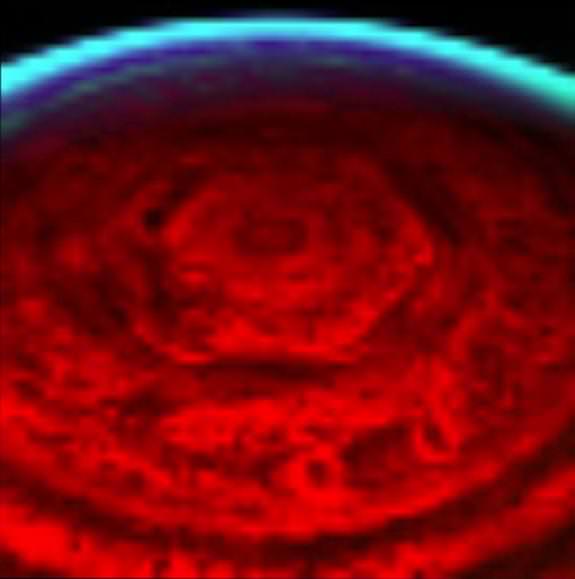
New Cassini infrared images of Saturn have revealed one of its strangest features - a bizarre six-sided cloud structure circling the entire north pole. This structure was hinted at when the Voyager spacecraft first visited the planet more than 20 years ago, but the new images from Cassini really show the structure in detail.

This cloud structure is similar to the Earth’s polar vortices, but instead of being circular, the clouds have build up this hexagonal shape. The hexagon extends much deeper than scientists previously believed, reaching 100 km (60 miles) below the cloud tops. Whatever this feature is, it’s only at the north pole. The south pole has a large storm, but it looks more like a hurricane with a giant eye.

Cassini hadn’t been able to image Saturn’s north pole until now because it was in winter in that area. This image was taken in the infrared spectrum, so it’s just variations in heat. Just like the Earth’s north pole, the region doesn’t see sunlight for a long time; in Saturn’s case, it takes 15 years of darkness. Saturn is moving out of its winter, now, and the region should be visible to Cassini’s other instruments.

Why has this cloud shape formed? That’s still a mystery.

Original Source: NASA/JPL/SSI News Release

May 3, 2005

Transit of Venus

No person alive today has seen the Transit of Venus, as it last happened in the year 1882, 122 years ago. As we live on earth, we can see only two planets transiting - Mercury & Venus. Transit of a planet is actually a very simple phenomenon to understand. When a planet is seen to move across sun (solar disk), it is called transit of the planet across solar disk. Transit are not visible without the help of telescopes, and that is the reason there are no mentions in ancient scripts, when viewed through a telescope, one sees a dense black spot on the sun, this spot appears to be moving, but very slowly. To see the transit through a telescope, solar filter lens is required, without such a filter one can become blind, so never see sun through the telescope without proper solar filters.

Another way of witnessing a transit is by projecting the sun through telescope on white paper. For this experiment no filters are required. Sun’s image is directly seen on the white board on paper, and if a transit is happening then a black spot is also seen. Along with this several other black markings will be seen, there are sunspots. So, how will one identify the planets black spot among many sun spots, as they all will be of almost some sizzle well, sunspots are dense black at the center but became blurred at the outer part, whereas planets black spot is dense black through out and is perfectly circular, sun spots may not be seen as perfect circles.

At the time of a transit, the planet while traveling in front of the sun actually blocks the light and that is why we see black spot over sun’s surface in other words it can be said absence of light. When the planet Mercury transits across the solar disk, its black spots size is very small, the reason for this is, mercury is a small planet and nearest to sun. Venus costs a bigger black spot because it is as big as Earth and is farther from sun than mercury is.

Transit of a planet happens only when sun, transits planet and earth come in one line and on the same side. We can see transits of Mercury & Venus because their orbits are inside the orbit of the Earth. But, if we go on Jupiter then we will be able to witness the transits of Mercury, Venus, Earth & Mars, and from Pluto, we will able to see all the planets transiting over the sun’s surface accept Pluto.

Transit of Mercury or Venus is a very interesting phenomenon and is also very important. It can be use to measure the distance, between Earth-Sun or Earth & the transiting planet. Johannes Kepler was the person who first calculated and predicted a transit, which was later proved to be accurate; unfortunately he was not alive to witness it.

Next transit of Venus will happen in 2012 June 6 and then the next pair of transits will take place in 2117 Dec 11 and 2125 Dec 08. Transit of Mercury happened in 2004 May 07 and next Mercury transit will take place in 2006 Nov 08.