Climate experts and representatives from 105 countries on Friday released a 24-page report on means of mitigating the worse impacts of global warming after five days of heated debates to reach a consensus on the document.
The report is focused on the economic implications and technological options for tackling global warming. It stated that emissions must start declining by 2015 to prevent the world's temperature from rising more than 2 degree Celsius over pre-industrialisation temperatures.
The report also stated that the low costs of buying insurance, through the use of technologies currently available, to avoid a climatic catastrophe in the coming decades is less than 0.1 percent of world GDP per annum.
Original Source: Deccan Herald

Showing posts with label Global Warming and Environment. Show all posts
Showing posts with label Global Warming and Environment. Show all posts


May 2, 2007
Sea Ice Loss Predictions Aren’t Conservative Enough
The effects of global warming are already being felt worldwide, but the Earth's poles are suffering the worst of it. Climate researchers have built a series of models to predict what impact rising temperatures will have on the amount of sea ice in the Arctic Ocean, and it appears they didn't make these models conservative enough. Sea ice is being depleted at triple the rate that was predicted.
The research was reported in a new study by the National Center for Atmospheric Research (NCAR) and the University of Colorado's National Snow and Ice Data Center (NSIDC). The authors compared simulations of of past climate to current observations on land and from space. The models estimated that ice would decrease at a rate of 2.5% per decade from 1953 to 2006. But the latest observations show that ice declined at an average rate of 7.8%. In other words, the decline of sea ice is currently about 30 years ahead of schedule from what researchers were originally predicting.
Several factors could have gone into the incorrect models, such as overestimating the thickness of present-day sea ice, or misunderstanding the atmospheric and oceanic circulation that transports heat to the polar regions.
Original Source: UCAR News Release
March 23, 2007
Snowball Earth Probably Had Warm Spots
 Planetary geologists propose that our planet once had periods of extreme global freezing nicknamed the “Snowball Earth” eras. During these periods, they supposed, the planet’s temperatures went so low that the oceans froze, and everything was covered in ice. Most sunlight was reflected back into space, perpetuating the icy period.
 But new evidence disputes this. By analyzing glacial sedimentary rocks in Oman, researchers have discovered evidence of hot-cold cycles roughly 850-544 million years ago - during the period when the Earth should have been in a deep freeze. Instead of being completely frozen over, with solid oceans, it appears that the Earth still had warm spots with open oceans; places where geologic processes could happen.
A global freeze would have been devastating to life. Without oceans there would be no evapouration and no weather system. Icy surfaces would have reflected much of the sunlight, keeping the Earth permanently cold. It appears that we got close, with the northern and southern icecaps nearly reaching one another. But we were fortunate to avoid that disaster.
Original Source: Imperial College News Release
February 23, 2007
Satellites Reveal Subglacial Streams in Antarctica
 Although it looks ancient and unchanging, the ice sheet in Antarctica is a surprisingly active place. Deep beneath the sheet’s surface, there are waterways, channels and pipes that connect various subglacial “lakes”. These channels can cause these lakes to drain away into the ocean, or transfer water from one to the other.
 Now data gathered by NASA satellites shows these fast-moving ice streams in action. The satellites - Terra, Aqua and ICESat - are able to measure changes in ice elevation as small as 1 metre (3 feet). As a subglacial lake drains, the elevation of ice above it falls accordingly.
These subglacial rivers seem to play an important role in the movement, growth and decay of the ice sheets above them. They could contribute a surprisingly large amount of the fresh water dumped into the nearby coastal oceans.
Original Source: NASA News Release
October 4, 2006
Biggest Ozone Hole Ever
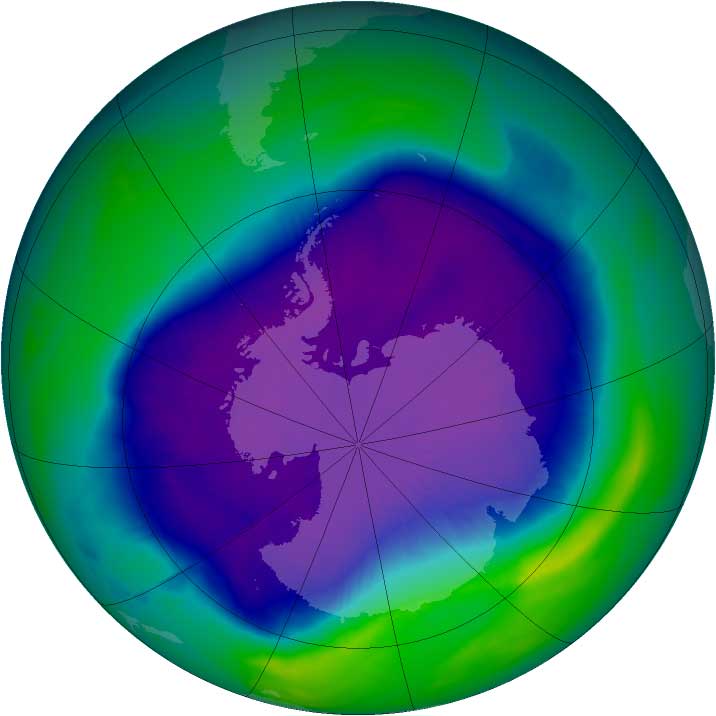 NASA and National Oceanic and Atmospheric Administration (NOAA) scientists report this year’s ozone hole in the polar region of the Southern Hemisphere has broken records for area and depth.
 The ozone layer acts to protect life on Earth by blocking harmful ultraviolet rays from the sun. The “ozone hole” is a severe depletion of the ozone layer high above Antarctica. It is primarily caused by human-produced compounds that release chlorine and bromine gases in the stratosphere.
“From September 21 to 30, the average area of the ozone hole was the largest ever observed, at 10.6 million square miles,” said Paul Newman, atmospheric scientist at NASA’s Goddard Space Flight Center, Greenbelt, Md. If the stratospheric weather conditions had been normal, the ozone hole would be expected to reach a size of about 8.9 to 9.3 million square miles, about the surface area of North America.
The Ozone Monitoring Instrument on NASA’s Aura satellite measures the total amount of ozone from the ground to the upper atmosphere over the entire Antarctic continent. This instrument observed a low value of 85 Dobson Units (DU) on Oct. 8, in a region over the East Antarctic ice sheet. Dobson Units are a measure of ozone amounts above a fixed point in the atmosphere. The Ozone Monitoring Instrument was developed by the Netherlands’ Agency for Aerospace Programs, Delft, The Netherlands, and the Finnish Meteorological Institute, Helsinki, Finland.
Scientists from NOAA’s Earth System Research Laboratory in Boulder, Colo., use balloon-borne instruments to measure ozone directly over the South Pole. By Oct. 9, the total column ozone had plunged to 93 DU from approximately 300 DU in mid-July. More importantly, nearly all of the ozone in the layer between eight and 13 miles above the Earth’s surface had been destroyed. In this critical layer, the instrument measured a record low of only 1.2 DU., having rapidly plunged from an average non-hole reading of 125 DU in July and August.
“These numbers mean the ozone is virtually gone in this layer of the atmosphere,” said David Hofmann, director of the Global Monitoring Division at the NOAA Earth System Research Laboratory. “The depleted layer has an unusual vertical extent this year, so it appears that the 2006 ozone hole will go down as a record-setter.”
Observations by Aura’s Microwave Limb Sounder show extremely high levels of ozone destroying chlorine chemicals in the lower stratosphere (approximately 12.4 miles high). These high chlorine values covered the entire Antarctic region in mid to late September. The high chlorine levels were accompanied by extremely low values of ozone.
The temperature of the Antarctic stratosphere causes the severity of the ozone hole to vary from year to year. Colder than average temperatures result in larger and deeper ozone holes, while warmer temperatures lead to smaller ones. The NOAA National Centers for Environmental Prediction (NCEP) provided analyses of satellite and balloon stratospheric temperature observations. The temperature readings from NOAA satellites and balloons during late-September 2006 showed the lower stratosphere at the rim of Antarctica was approximately nine degrees Fahrenheit colder than average, increasing the size of this year’s ozone hole by 1.2 to 1.5 million square miles.
The Antarctic stratosphere warms by the return of sunlight at the end of the polar winter and by large-scale weather systems (planetary-scale waves) that form in the troposphere and move upward into the stratosphere. During the 2006 Antarctic winter and spring, these planetary-scale wave systems were relatively weak, causing the stratosphere to be colder than average.
As a result of the Montreal Protocol and its amendments, the concentrations of ozone-depleting substances in the lower atmosphere (troposphere) peaked around 1995 and are decreasing in both the troposphere and stratosphere. It is estimated these gases reached peak levels in the Antarctica stratosphere in 2001. However, these ozone-depleting substances typically have very long lifetimes in the atmosphere (more than 40 years).
As a result of this slow decline, the ozone hole is estimated to annually very slowly decrease in area by about 0.1 to 0.2 percent for the next five to 10 years. This slow decrease is masked by large year-to-year variations caused by Antarctic stratosphere weather fluctuations.
The recently completed 2006 World Meteorological Organization/United Nations Environment Programme Scientific Assessment of Ozone Depletion concluded the ozone hole recovery would be masked by annual variability for the near future and the ozone hole would fully recover in approximately 2065.
“We now have the largest ozone hole on record,” said Craig Long of NCEP. As the sun rises higher in the sky during October and November, this unusually large and persistent area may allow much more ultraviolet light than usual to reach Earth’s surface in the southern latitudes.
Original Source: NASA News Release
September 25, 2006
Warmest World in 12,000 Years
 A new study by NASA climatologists finds that the world’s temperature is reaching a level that has not been seen in thousands of years.
 The study appears in the current issue of the Proceedings of the National Academy of Sciences, authored by James Hansen of NASA’s Goddard Institute for Space Studies, N.Y. and colleagues from Columbia University, Sigma Space Partners, Inc., and the University of California at Santa Barbara (UCSB). The study concludes that, because of a rapid warming trend over the past 30 years, the Earth is now reaching and passing through the warmest levels in the current interglacial period, which has lasted nearly 12,000 years. This warming is forcing a migration of plant and animal species toward the poles.
The study includes worldwide instrumental temperature measurements during the past century. These data reveal that the Earth has been warming at the remarkably rapid rate of approximately 0.2° Celsius (.36° Fahrenheit) per decade for the past 30 years. This observed warming is similar to the warming rate predicted in the 1980s in initial global climate model simulations with changing levels of greenhouse gases.
“This evidence implies that we are getting close to dangerous levels of human-made (anthropogenic) pollution,” said Hansen. In recent decades, human-made greenhouse gases (GHGs) have become the dominant climate change factor.
The study notes that the world’s warming is greatest at high latitudes of the Northern Hemisphere, and it is larger over land than over ocean areas. The enhanced warming at high latitudes is attributed to effects of ice and snow. As the Earth warms, snow and ice melt, uncovering darker surfaces that absorb more sunlight and increase warming, a process called a positive feedback. Warming is less over ocean than over land because of the great heat capacity of the deep-mixing ocean, which causes warming to occur more slowly there.
Hansen and his colleagues in New York collaborated with David Lea and Martin Medina-Elizade of UCSB to obtain comparisons of recent temperatures with the history of the Earth over the past million years. The California researchers obtained a record of tropical ocean surface temperatures from the magnesium content in the shells of microscopic sea surface animals, as recorded in ocean sediments.
One of the findings from this collaboration is that the Western Equatorial Pacific and Indian Oceans are now as warm as, or warmer than, at any prior time in the Holocene. The Holocene is the relatively warm period that has existed for almost 12,000 years, since the end of the last major ice age. The Western Pacific and Indian Oceans are important because, as these researchers show, temperature change there is indicative of global temperature change. Therefore, by inference, the world as a whole is now as warm as, or warmer than, at any time in the Holocene.
According to Lea, “The Western Pacific is important for another reason, too: it is a major source of heat for the world’s oceans and for the global atmosphere.â€
In contrast to the Western Pacific, the researchers find that the Eastern Pacific Ocean has not shown an equal magnitude of warming. They explain the lesser warming in the East Pacific Ocean, near South America, as being due to the fact this region is kept cool by upwelling, rising of deeper colder water to shallower depths. The deep ocean layers have not yet been affected much by human-made warming.
Hansen and his colleagues suggest that the increased temperature difference between the Western and Eastern Pacific may boost the likelihood of strong El Ninos, such as those of 1983 and 1998. An El Nino is an event that typically occurs every several years when the warm surface waters in the West Pacific slosh eastward toward South America, in the process altering weather patterns around the world.
The most important result found by these researchers is that the warming in recent decades has brought global temperature to a level within about one degree Celsius (1.8° F) of the maximum temperature of the past million years. According to Hansen “That means that further global warming of 1 degree Celsius defines a critical level. If warming is kept less than that, effects of global warming may be relatively manageable. During the warmest interglacial periods the Earth was reasonably similar to today. But if further global warming reaches 2 or 3 degrees Celsius, we will likely see changes that make Earth a different planet than the one we know. The last time it was that warm was in the middle Pliocene, about three million years ago, when sea level was estimated to have been about 25 meters (80 feet) higher than today.â€
Global warming is already beginning to have noticeable effects in nature. Plants and animals can survive only within certain climatic zones, so with the warming of recent decades many of them are beginning to migrate poleward. A study that appeared in Nature Magazine in 2003 found that 1700 plant, animal and insect species moved poleward at an average rate of 6 kilometers (about 4 miles) per decade in the last half of the 20th century.
That migration rate is not fast enough to keep up with the current rate of movement of a given temperature zone, which has reached about 40 kilometers (about 25 miles) per decade in the period 1975 to 2005. “Rapid movement of climatic zones is going to be another stress on wildlife†according to Hansen. “It adds to the stress of habitat loss due to human developments. If we do not slow down the rate of global warming, many species are likely to become extinct. In effect we are pushing them off the planet.â€
Original Source: NASA News Release
Subscribe to:
Posts (Atom)